
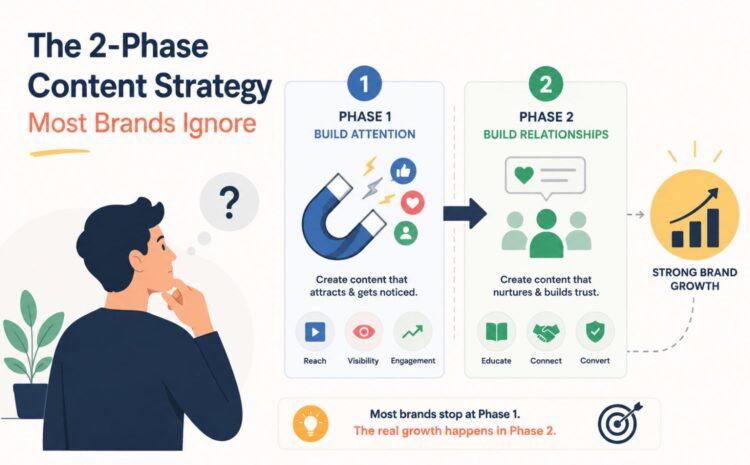
The 2-Phase Content Strategy Most Brands Ignore
|
Getting your Trinity Audio player ready...
|
Why Most Brand Content Fails
Most brands today are creating more content than ever before, but very few are creating content that actually improves business growth in a meaningful way. Businesses are posting regularly on Instagram, publishing blogs on their websites, running paid advertisements, sending email campaigns, and trying to stay active across multiple platforms where customers might be present.
From the outside, this creates the impression that the marketing system is strong because the brand looks visible, active, and engaged. However, when business owners look at the actual results, they often notice the same frustrating problem—content is being published consistently, but revenue is not growing at the same pace.
This happens because most businesses mistake content activity for content strategy. Being busy with content does not automatically mean the content is helping people move toward a buying decision. In many cases, brands are only creating awareness and visibility, but they are not creating the trust and confidence required for conversion.
This usually happens because businesses focus only on:
- social media posting consistency
- website traffic and impressions
- likes, comments, and engagement
- ad reach and visibility metrics
While these are important, they are not enough to create predictable revenue.
That is why many businesses feel like their marketing is working and failing at the same time. People are watching, clicking, and engaging, but they are not converting into serious leads or paying customers.
The real issue is not a lack of content. The real issue is an incomplete content system.
What Is the 2-Phase Content Strategy
The 2-phase content strategy is a practical framework that helps businesses stop treating every piece of content the same and start using content with a clear business purpose.
Instead of assuming all content should sell directly, this strategy divides content into two important stages that reflect how people actually make buying decisions in the real world.
The strategy works in two simple phases:
- Phase One focuses on attention and visibility
- Phase Two focuses on trust and conversion
The first phase helps people discover your brand, start recognizing your name, and understand what your business does. At this stage, the goal is not immediate sales. The goal is familiarity and relevance.
The second phase helps people trust your business, understand your value, and feel confident enough to take action. This is where revenue actually begins.
Most businesses work very hard on the first phase and completely ignore the second one. They keep producing content that attracts attention, but they never create the deeper content that helps customers feel ready to buy.
At Fifth Shield, this is one of the most common issues we notice while reviewing business content strategies. Brands are investing time and money into visibility, but because they are missing the second phase, their marketing efforts struggle to produce strong revenue outcomes.
Phase One: Building Attention Before Asking for Sales
The first phase of content strategy is about helping people notice your business without immediately pushing them toward a purchase. This is important because most people do not buy from a brand they have just discovered for the first time.
Customers need familiarity before they trust, and they need trust before they take action.
This phase includes content such as:
- SEO blogs
- educational social media posts
- awareness campaigns
- short-form videos
- brand storytelling
- informational content
For example, a person may discover your business through a Google search while reading a blog post. Later, they may see your Instagram reel explaining the same topic from a different angle. A few days later, they might come across your ad again while browsing online.
At this point, they may still not be ready to buy, but your brand is no longer unfamiliar. That repeated exposure creates recognition, and recognition is the first step toward trust.
This is why awareness content is important. It creates the beginning of the relationship. It allows your brand to enter the customer’s mind before the buying decision even starts.
However, many businesses make the mistake of staying here too long. They become experts at being seen, but not at being chosen.
Phase Two: Turning Attention into Trust and Revenue
This is the phase where real business growth happens, and unfortunately, it is also the phase most brands ignore.
Once people are aware of your business, they begin asking more serious questions. They want to know whether your service is reliable, whether your results are real, and whether choosing your business is the right decision compared to other available options.
This is where conversion-focused content becomes necessary.
Phase Two includes:
- landing pages
- case studies
- client testimonials
- service pages
- comparison pages
- retargeting campaigns
- email nurturing sequences
For example, a potential customer may first discover your business through a blog post, but they may only decide to contact you after reading a strong case study that shows real results or after seeing testimonials from previous clients who had a successful experience.
This is the difference between awareness and conversion.
Even the best-performing digital marketing agency in Delhi NCR understands that trust-building content often creates stronger business outcomes than awareness content alone. Visibility gets people to notice you, but trust is what makes them choose you.
Without this second phase, businesses create traffic without transformation.
Why Most Businesses Never Reach Phase Two
One of the biggest reasons businesses stop after Phase One is because awareness content feels easier and more rewarding in the short term.
It produces visible activity. Likes, comments, views, shares, and impressions create the feeling that marketing is moving forward. These numbers are easy to track, and they give quick feedback.
Phase Two feels different because it requires:
- understanding customer objections
- improving sales messaging
- building proof and authority
- stronger decision-making content
- deeper customer psychology
Because it takes more thinking and less instant validation, many businesses avoid it without realizing it. They continue creating social media posts, blogs, and ads because these actions feel productive, even when they are not improving actual sales performance.
This creates a dangerous illusion of growth where the brand looks busy from the outside, but the revenue engine remains weak on the inside.
Activity is visible. Conversion problems are hidden.
That is why businesses often say their marketing feels active, but their sales still feel unpredictable.
How Incomplete Content Strategy Creates Revenue Gaps
When a business focuses only on visibility and ignores trust-building content, it creates what can be called a revenue gap.
This gap usually looks like:
- traffic increases, but leads remain weak
- social engagement improves, but inquiries do not grow
- advertising budgets rise, but ROI stays inconsistent
- people know the brand, but they still do not buy
This happens because awareness without trust creates hesitation.
People may know your business exists, but they still do not feel confident enough to buy. They may like your content, but they are not convinced by your offer. They may visit your website, but they leave without taking action.
This is one of the biggest reasons businesses feel confused about marketing results. They are doing “everything right” from a visibility perspective, but sales remain unstable.
The issue is usually not poor content quality.
The issue is missing content between attention and conversion.
Without trust-building assets, your marketing keeps opening the door, but nothing helps the customer feel ready to walk through it.
How to Build a Strong 2-Phase Content System
The best way to fix this problem is by looking at your content strategy honestly and asking whether your content is helping people move forward or simply helping your brand stay visible.
For every awareness piece you create, there should be a conversion-focused step connected to it.
A simple system looks like this:
- SEO blog → service page
- social media post → case study
- awareness ad → landing page
- Instagram reel → testimonial proof
- lead magnet → email nurturing sequence
Content should work like a journey, not like isolated pieces published randomly.
A person should be able to discover your brand, trust your authority, and understand exactly what action to take next.
That is what separates content marketing from real content strategy.
The goal is not simply to keep publishing.
The goal is to create movement from attention to trust, and from trust to revenue.
Fifth Shield
At Fifth Shield, we help businesses move beyond random content creation and build complete marketing systems that support long-term business growth.
As a performance-focused Affordable SEO Company in Delhi, we understand that visibility alone does not create revenue. A brand must also build trust, authority, and confidence if it wants conversions to happen consistently.
From SEO blogs and content strategy to landing pages, retargeting systems, service positioning, and conversion-focused messaging, we help businesses create content that does more than generate attention.
We focus on:
- stronger SEO visibility
- better lead generation systems
- trust-building content assets
- conversion-focused landing pages
- long-term revenue growth strategies
Because content should not simply make your brand look active.
It should help your business grow with clarity and predictability.
Final Thoughts
Most brands are not struggling because they create too little content. They are struggling because they stop too early in the customer journey.
They focus on getting attention, but they forget the importance of building trust. They work hard to be seen, but they do not build enough confidence to be chosen.
That is why content often feels busy without becoming profitable.
The 2-phase content strategy solves this by giving every piece of content a clear purpose inside the customer journey. It turns publishing into a system, visibility into trust, and trust into real revenue growth.
Because in digital marketing, success does not come from simply being visible.
It comes from helping the right people feel confident enough to choose you.
Also Read:-The Attention Economy: Why You’re Losing Before You Start