
|
Getting your Trinity Audio player ready...
|
Introduction: Why Cost Per Lead Keeps Increasing in Digital Marketing
Cost Per Lead (CPL) is one of the most critical metrics in digital marketing, but most businesses struggle with rising CPL without understanding the real reason behind it. The problem is rarely the ad budget—it is almost always poor audience targeting.
When ads are shown to the wrong audience, conversion rates drop and acquisition cost increases automatically. Even high-performing campaigns become inefficient when targeting is broad or misaligned with user intent.
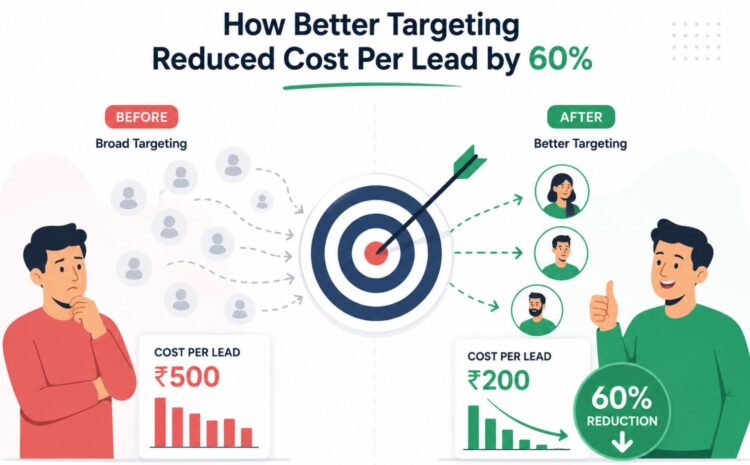
In a real campaign optimization scenario, improving targeting strategy alone helped reduce Cost Per Lead by 60% without increasing ad spend, proving that audience quality has a direct impact on marketing ROI.
What Is Cost Per Lead (CPL) in Digital Marketing?
Cost Per Lead (CPL) refers to the total cost spent to acquire one qualified lead from digital marketing campaigns. It is widely used to measure the efficiency of paid ads, lead generation funnels, and performance marketing campaigns.
A lower CPL indicates better targeting, higher conversion rates, and stronger campaign efficiency, while a higher CPL signals wasted ad spend or poor audience segmentation.
- Measures cost per acquired lead
- Depends on conversion efficiency
- Indicates campaign performance health
- Lower CPL improves overall ROI
Why Most Businesses Struggle With High Cost Per Lead
The biggest reason for high CPL is not competition or ad platform changes—it is inefficient targeting. Many businesses focus on increasing reach instead of improving audience quality, which leads to irrelevant clicks and low-intent traffic.
This results in poor conversion rates and higher cost per acquisition. Even businesses working with a digital marketing agency in Delhi NCR often discover that targeting inefficiency is the root cause of high CPL.
- Broad targeting attracts low-quality traffic
- Irrelevant users reduce conversion rate
- Weak segmentation increases ad waste
- Low intent leads increase acquisition cost
The Targeting Strategy That Reduced CPL by 60%
The CPL reduction was achieved by restructuring the entire targeting system into three layers: cold audience, warm audience, and high-intent audience segmentation.
Instead of targeting broad demographics, campaigns were optimized to focus on users showing real buying signals such as search behavior, engagement history, and previous interactions with the brand.
Cold traffic was minimized, while retargeting and intent-based audiences were prioritized, resulting in higher conversion rates and significantly lower wasted ad spend.
- Focus on high-intent audience targeting
- Reduce irrelevant cold traffic exposure
- Strengthen retargeting campaigns strategy
- Improve segmentation and filtering system
How Better Targeting Improves Conversion Rate
Better targeting directly improves conversion rate because ads are shown to users who already have interest, need, or awareness of the solution. This reduces friction in the decision-making process and increases the probability of conversion.
When audience relevance increases, fewer users drop off, and more clicks turn into qualified leads, which directly reduces Cost Per Lead.
- Higher intent increases conversions
- Reduces decision-making friction
- Improves lead quality significantly
- Increases campaign efficiency rate
Role of Intent-Based Targeting in Reducing CPL
Intent-based targeting focuses on users who are actively searching, engaging, or showing behavioral signals that indicate purchase readiness. This ensures that ad spend is directed only toward high-value audiences.
Unlike broad targeting, intent-based campaigns eliminate irrelevant traffic and improve conversion efficiency, making CPL significantly lower.
- Targets users with buying intent
- Improves lead qualification quality
- Reduces wasted advertising spend
- Increases conversion probability
Common Mistakes That Increase Cost Per Lead
Most businesses unknowingly increase CPL by scaling campaigns without optimizing targeting or relying only on demographic-based audiences instead of behavior-driven insights.
Another major mistake is ignoring retargeting, which leads to loss of warm leads that are already close to conversion.
- Scaling without optimization strategy
- Ignoring behavioral audience signals
- Weak or missing retargeting setup
- Over-reliance on broad targeting
Why Small Targeting Improvements Deliver Big CPL Reduction
Targeting is one of the highest-impact factors in performance marketing. Even a small improvement in audience quality can significantly increase conversion rates and reduce cost per lead.
When irrelevant traffic is eliminated, every click becomes more valuable, and overall marketing efficiency improves without increasing budget.
- Small changes improve efficiency
- Eliminates wasted ad spend quickly
- Boosts conversion rate instantly
- Improves ROI significantly
How to Reduce Cost Per Lead Effectively
Reducing CPL requires continuous optimization of targeting, audience segmentation, and conversion pathways. Businesses must focus on identifying high-intent users and reallocating budget toward audiences that convert consistently.
Retargeting strategies and data-driven optimization play a key role in maintaining low CPL over time.
- Optimize audience segmentation regularly
- Focus on high-intent users only
- Strengthen retargeting performance strategy
- Use data-driven optimization approach
Why Choose Fifth Shield
Fifth Shield is a result-driven internet marketing company in Dwarka focused on reducing Cost Per Lead through smarter targeting and performance-based strategies.
We help businesses attract high-intent users, improve conversion rates, and eliminate wasted ad spend using data-driven campaigns, retargeting, and continuous optimization.
If your CPL is rising, we fix the real issue your targeting, not your budget and turn your ads into a consistent lead-generation system.
Final Thoughts: CPL Is Driven by Targeting, Not Budget
Cost Per Lead is not determined by how much you spend, but by who you are targeting. When audience quality improves, conversion rate increases and acquisition cost naturally decreases.
The 60% reduction in CPL proves that smarter targeting strategies are more effective than increasing ad budgets. Once targeting is optimized, every other marketing metric ROI, conversions, and profitability improves automatically.
- CPL depends on targeting accuracy
- Better audience improves ROI
- Data drives performance efficiency
- Smart targeting reduces marketing waste
Also Read:- The ₹10,000 Marketing Experiment: What Actually Worked