
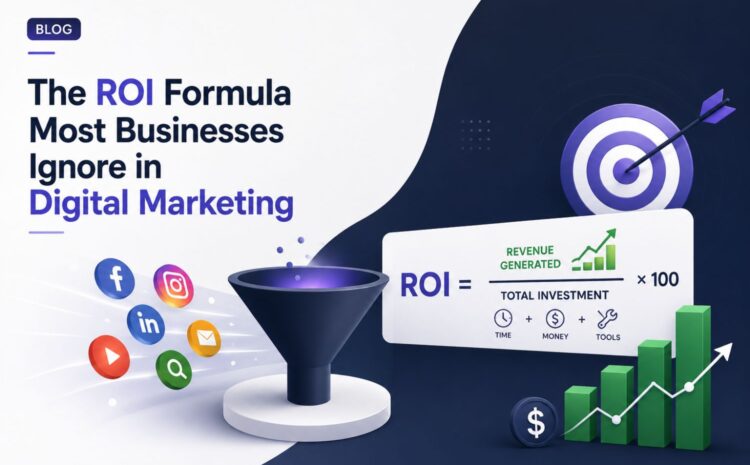
The ROI Formula Most Businesses Ignore in Digital Marketing
|
Getting your Trinity Audio player ready...
|
Most businesses believe they understand ROI in digital marketing They consider their earnings and advertising expenditures to be the complete picture. On the surface, it feels logical. But in real-world marketing, that calculation is incomplete.
Because digital marketing doesn’t work in a straight line. It works in layers traffic, attention, engagement, trust, conversion, and retention. If even one of these layers is weak, your ROI becomes misleading.
This is the reason many businesses think their marketing is working, while in reality they are leaking profit without realizing it.
True ROI is not just about spending ₹1 and earning ₹2. It is about understanding what happens between that spend and that return.
Why Traditional ROI Thinking Fails
The most common ROI formula businesses use is very simple:
Revenue – Marketing Cost = Profit
While this looks clean and easy, it ignores the reality of digital behavior.
Not every lead becomes a customer. Not every customer buys again. Not every click has value. And not every sale is profitable after operational costs.
For example, a campaign might generate 200 leads, but only 10 of them convert into paying customers. On paper, it may still look like success, but the actual cost per real customer becomes much higher than expected.
This is where most businesses make scaling mistakes.
They increase budget based on incomplete data and end up spending more without improving real profitability.
Even many brands working with an online marketing agency in Delhi initially struggle with this because they track only surface-level numbers instead of true business value.
The Real ROI Formula in Digital Marketing
A more realistic way to understand ROI in digital marketing looks deeper than just revenue.
A better working formula is:
ROI = (Customer Lifetime Value × Conversion Rate × Lead Quality) − Total Marketing Cost
This formula changes everything because it includes what actually matters in business growth.
Customer Lifetime Value tells you how much one customer is worth over time, not just their first purchase. Conversion Rate shows how effectively your marketing turns interest into action. Lead Quality determines whether your traffic is actually relevant or just random visitors. And Total Marketing Cost includes everything from ads to tools and operations.
Once businesses start looking at ROI this way, they realize why some campaigns that “look profitable” are actually not sustainable long-term.
Hidden Costs That Most Businesses Ignore
One of the biggest mistakes in ROI calculation is ignoring hidden costs.
These are not always visible in your ad dashboard, but they directly impact profitability.
Poor landing pages reduce conversions. Weak website experience increases drop-offs. Slow follow-ups reduce lead value. And unqualified leads waste sales time.
Even your team’s time spent filtering low-quality leads is a cost, even if it is not recorded in your ad budget.
When all of these are ignored, ROI becomes artificially inflated, which leads to wrong business decisions.
Why Lead Quality Matters More Than Lead Quantity
Many businesses celebrate getting more leads. But in digital marketing, more leads do not always mean more profit.
If those leads are not relevant, not interested, or not ready to buy, they only increase workload without increasing revenue.
A smaller number of high-quality leads often generates better ROI than large volumes of low-quality traffic.
This is why targeting strategy, audience segmentation, and messaging clarity matter so much in digital campaigns.
Better targeting always leads to better ROI, even without increasing budget.
The Real Role of Conversion Rate
Conversion rate is one of the most powerful but ignored parts of ROI.
Even a small improvement can dramatically change profitability.
If your conversion rate improves from 2% to 4%, your revenue effectively doubles from the same traffic without increasing ad spend.
This is why optimization matters more than just advertising.
Businesses that work with a professional digital marketing agency in Delhi usually focus heavily on improving landing pages, messaging clarity, and user experience because that directly increases ROI without increasing cost.
Why Businesses Misjudge Scaling
A common mistake is scaling campaigns too early.
When initial results look good, businesses increase budgets without fully understanding long-term performance. This often leads to wasted spend because early results are not always stable.
Proper ROI measurement requires time, testing, and optimization before scaling.
Without that patience, businesses end up increasing cost instead of increasing profit.
How to Improve ROI in Digital Marketing
Improving ROI is not about cutting budgets. It is about improving efficiency.
Better targeting ensures ads reach the right audience. Strong landing pages increase conversions. Clear messaging reduces confusion. And consistent tracking ensures you understand where money is actually being lost.
When all these elements work together, ROI naturally improves without aggressive spending changes.
Final Thoughts
Most businesses do not struggle because digital marketing does not work. They struggle because they measure it incorrectly.
When ROI is calculated only on revenue and ad spend, it gives a false sense of performance. But when customer value, conversion efficiency, and lead quality are included, the real picture becomes much clearer.
In most cases, the problem is not marketing itself. The problem is how success is being measured.
Once that changes, decision-making becomes smarter, campaigns become more efficient, and profitability improves significantly.
FAQ
Q1.What is ROI in digital marketing?
Ans: ROI in digital marketing refers to the return you earn from your marketing investment compared to the total cost spent on campaigns, tools, and resources.
Q2. Why is ROI calculation often wrong in digital marketing?
Ans: Most businesses ignore hidden costs like poor conversion rates, weak lead quality, and operational inefficiencies, which makes ROI look better than it actually is.
Q3. What is the best ROI formula for digital marketing?
Ans: A more accurate formula is: Customer Lifetime Value × Conversion Rate × Lead Quality minus Total Marketing Cost.
Q4. How can I improve ROI quickly?
Ans: You can improve ROI by improving targeting, optimizing landing pages, increasing conversion rates, and focusing on high-quality leads instead of just volume.
Q5. Does working with an agency improve ROI?
Ans: Yes, a professional digital marketing agency can help improve ROI by optimizing campaigns, improving conversion systems, and reducing wasted ad spend.
Also Read :- Why First Impressions Online Decide Nearly 80 of Your Sales