
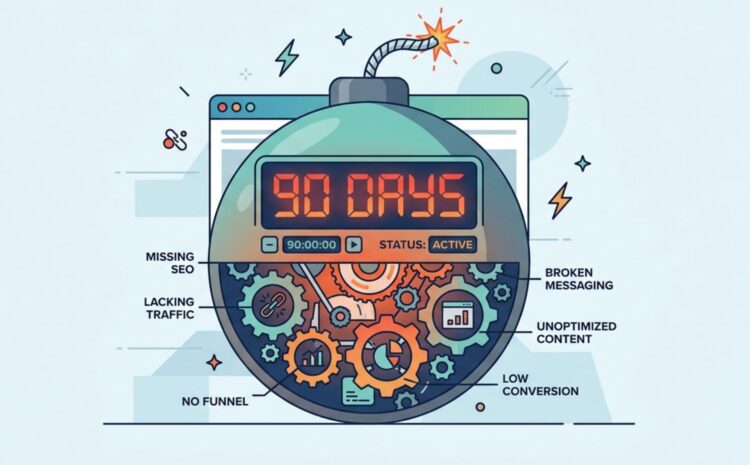
Why Most Business Websites Fail Within 90 Days
|
Getting your Trinity Audio player ready...
|
Did you know that a majority of business websites fail to generate meaningful results within the first 90 days of launch? Not because the design is bad or the developer made mistakes, but because the strategy behind the website is missing.
In today’s digital landscape, simply launching a website is no longer enough. Many business owners expect instant traffic, leads, and conversions, but when that doesn’t happen, the website is often labeled as “not working.”
The truth is, most websites don’t fail because they are broken—they fail because they are built without a clear understanding of user intent, conversion psychology, and local SEO strategy.
Table of Contents
The Real Reason Websites Fail So Quickly
Most business owners assume that once a website is live, customers will automatically start coming in. This is the biggest misconception.
A website is not a magic tool it is a system that needs visibility, structure, and continuous optimization.
Research across digital marketing industries shows that a large percentage of new websites fail to generate consistent leads within the first 90 days because they are built without a clear marketing funnel.
The real issue is not design it is direction.
A successful website must answer three questions immediately:
- Who is the target audience?
- How will traffic come in?
- What action should users take?
When these are missing, the website becomes invisible in performance, even if it looks visually perfect.
No Clear Traffic Strategy from Day One
One of the most common reasons websites fail is the absence of a proper traffic plan before launch.
Businesses often invest in design but completely ignore how users will actually find the website.
Without traffic, even the best website is just a digital brochure.
A strong traffic foundation usually comes from:
- SEO targeting high-intent keywords
- Google Business Profile optimization for local visibility
- Paid ads for immediate reach
- Content marketing for long-term organic traffic
The mistake most businesses make is treating traffic as a “post-launch activity.” In reality, traffic planning should start before the website goes live.
Poor Website Conversion Optimization
Even when traffic comes in, many websites still fail because they are not built to convert visitors into leads or customers.
Conversion optimization is about guiding the user step-by-step toward action.
When this is missing, users visit the website but leave without doing anything.
Common conversion issues include:
- Confusing layouts that make users think too much
- Weak or unclear call-to-action buttons
- Slow loading pages that reduce engagement
- Lack of trust signals like testimonials or case studies
A well-optimized website removes confusion and reduces friction so users can take action easily.
For example:
Instead of saying “Submit”, a strong CTA would be “Get Your Free Consultation”.
Small changes like this can significantly increase conversions.
Ignoring Local SEO and Search Intent
Many businesses fail because they ignore how users actually search online.
Most searches today are location-based and intent-driven, such as:
- “best digital marketing agency near me”
- “salon in Dwarka Delhi”
- “SEO services for small business”
If your website is not optimized for these types of searches, you lose high-quality leads.
Local SEO focuses on:
- Using location-based keywords naturally in content
- Optimizing Google Business Profile
- Creating service pages for specific areas
- Building local citations and backlinks
Without local SEO, your website may exist—but it won’t be visible to the right audience.
Content That Doesn’t Build Trust or Authority
This is one of the most ignored reasons for website failure.
A website without strong content cannot rank on Google, and more importantly, it cannot build trust with users.
Most businesses make the mistake of thinking content means just writing a few service descriptions. But in reality, content is what educates, convinces, and converts a visitor.
Strong content does three important things:
- It educates the user
- It builds trust and authority
- It guides the user toward taking action
Let’s break it properly:
When a user lands on your website, they are usually not ready to buy immediately. They are still comparing options, understanding pricing, and evaluating credibility.
Good content helps by explaining:
- What your service actually solves
- Why your solution is better than competitors
- How the process works step-by-step
- What results they can expect
Trust is built when users feel understood. If your content directly answers their doubts, they start seeing your brand as an expert instead of just another business.
For example:
Instead of just writing “We provide SEO services,” better content explains:
- What problems SEO solves
- How long results take
- What strategies are used
- What industries you specialize in
This kind of content builds authority in the user’s mind and increases conversion probability.
Agencies like Fifth Shield often structure website content in this way—so every page not only informs but also moves users closer to inquiry.
Lack of Data Tracking and Performance Analysis
Another major reason websites fail is because businesses never analyze performance after launch.
Without data, everything becomes guesswork.
Most businesses don’t know:
- Which pages users are visiting
- Where users are dropping off
- Which traffic sources are working
- What content is performing best
Tools like Google Analytics and heatmaps show real user behavior.
Successful websites are constantly improved based on this data. Without it, even good websites slowly stop performing.
How Fifth Shield Helps Businesses Avoid Website Failure
Most websites fail because they are built as a one-time project instead of a long-term system.
A structured approach, like the one followed by Fifth Shield, focuses on building websites that are designed for performance from day one.
Instead of just focusing on design, the approach includes:
- SEO-first website planning
- Conversion-focused structure
- Local SEO integration for visibility
- Content strategy based on user intent
- Continuous tracking and optimization
This ensures that a website is not just launched it is actively built to generate traffic, leads, and measurable business growth within the critical first 90 days.
How to Build a Website That Actually Works
A successful website is not just visually appealing it is strategically designed.
It should include:
- Clear traffic acquisition plan before launch
- Strong SEO foundation
- Conversion-focused messaging
- Educational content that builds trust
- Continuous improvement based on analytics
When all these elements work together, the website becomes a business asset—not just an online presence.
Wrapping Up
Most business websites fail within 90 days not because they are poorly designed, but because they lack strategy, clarity, and optimization.
A website without traffic, content depth, and conversion planning cannot perform in a competitive digital environment.
The real success comes when businesses treat their website as a system that evolves, improves, and converts over time.
When this structured approach is followed—often with expert guidance from teams like Fifth Shield—websites stop failing and start becoming consistent growth engines.
Don’t miss :- What is Cheap Marketing Paradox: Why Cheap Marketing Fails and Leads to High Loss?