
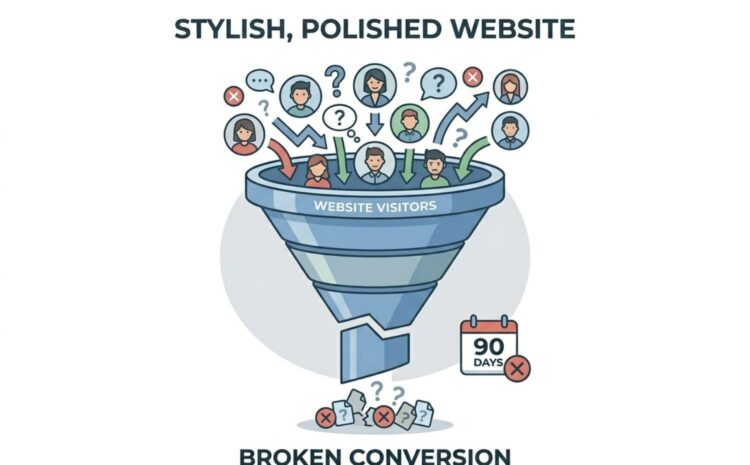
Why Your Website Looks Good but Still Doesn’t Generate Leads
|
Getting your Trinity Audio player ready...
|
Many businesses today invest heavily in website design. They focus on modern layouts, animations, colors, and visuals. The website looks professional, clean, and even impressive. But despite all of this, one major problem remains the website does not generate leads.
This is one of the most common issues in digital marketing today. A visually attractive website does not automatically mean it is effective. Lead generation depends on strategy, psychology, user experience, and optimization, not just design.
Businesses working with experts like Fifth Shield often discover that the real issue is not how the website looks, but how it performs in terms of conversion and user behavior.
In this article, you will understand why your website looks good but still doesn’t generate leads, and what factors are actually responsible for low conversions.
Table of Contents
The Design vs Conversion Gap
One of the biggest misconceptions in business is believing that a good-looking website equals a high-performing website.
Design only improves appearance, but conversion depends on clarity and strategy. A website may look premium, but if it does not guide the user toward an action, it fails as a marketing tool.
Many businesses focus on visuals but ignore structure, messaging, and psychology. As a result, users visit the website, like the design, and leave without taking any action.
This gap between design and conversion is the primary reason many websites fail to generate leads.
No Clear Value Proposition
When a user lands on your website, they should immediately understand three things:
- What you do
- Who you help
- Why they should choose you
If this is not clear within the first few seconds, users lose interest.
Many websites use generic headlines like “We provide the best solutions” or “We deliver quality services.” These statements do not explain value clearly.
A strong value proposition is specific and benefit-driven. For example, instead of saying “digital marketing services,” a better message would be “We help local businesses increase leads through SEO and Google Ads.”
Agencies like Fifth Shield often restructure website messaging to ensure clarity and conversion focus from the first section.
Weak Call-to-Actions (CTAs)
A website without strong CTAs is like a shop without a counter.
Many websites either hide their CTAs or use unclear phrases like “Submit” or “Click Here.” These do not encourage users to take action.
Effective CTAs should be:
- Clear
- Action-oriented
- Visible
- Value-driven
Examples include “Get Free Consultation,” “Book a Demo,” or “Request a Quote.”
If users do not know what to do next, they will simply leave the website, even if they are interested.
Poor User Experience and Navigation
User experience plays a major role in lead generation. Even a visually beautiful website can fail if it is difficult to navigate.
Common issues include:
- Slow loading speed
- Confusing menu structure
- Too many distractions
- Poor mobile optimization
Most users today browse on mobile devices. If your website is not mobile-friendly, you lose a significant portion of potential leads.
A smooth and intuitive navigation system helps users find information quickly and move naturally toward conversion points.
No Traffic Strategy or Wrong Traffic
Sometimes the website is not the problem—the traffic is.
If your website attracts the wrong audience, it will not generate leads regardless of how good it looks.
For example, if you offer local services but your traffic comes from unrelated regions or audiences, conversions will remain low.
This is where SEO, Google Ads, and local targeting become important. Focused traffic always performs better than random traffic.
This is why businesses often rely on a structured approach from experts like Fifth Shield to attract high-intent users who are more likely to convert.
Lack of Trust Signals
Users do not trust new websites immediately. They look for proof before taking action.
If your website does not have trust signals, users will hesitate to contact you.
Important trust elements include:
- Customer reviews
- Case studies
- Client logos
- Testimonials
- Certifications
- Real images of your work
Without these elements, even a well-designed website feels incomplete or risky to users.
Trust is a key factor in conversion, especially for service-based businesses.
No Lead Funnel or Strategy
A lead funnel guides users step-by-step from awareness to conversion. Without it, users visit your site and leave without any direction.
A proper funnel includes:
- Landing pages for specific services
- Lead capture forms
- Follow-up systems like email or WhatsApp
- Retargeting campaigns
When these elements are missing, your website cannot convert traffic into leads effectively.
Businesses that implement structured funnels with support from agencies like Fifth Shield often see a significant improvement in lead generation.
Psychological Reasons Websites Fail
Most websites fail because of psychology:
- Cognitive Overload
Too many options confuse users.
- Decision Fatigue
Users are unsure on what to do next.
- Trust Friction
No proof = no action.
- Attention Drop (3–5 seconds rule)
If value is not clear instantly, users leave.
- Unclear Reward
Users don’t understand what they gain.
Understanding these factors is key to improving website conversion rate.
FAQ
Q1. Why does my website get traffic but no leads?
This usually happens due to weak CTAs, poor messaging, or lack of conversion strategy.
Q2. Does website design affect lead generation?
Yes, but only partially. Design improves user experience, but conversion depends on strategy and structure.
Q3. How can I increase leads from my website?
Improve CTAs, optimize content, target the right audience, and add trust signals.
Q4. What is the biggest reason websites fail to convert?
Lack of clear value proposition and poor lead funnel structure.
Q5. Can SEO help improve website leads?
Yes, SEO brings high-intent traffic, which increases chances of conversion.
Wrapping Up
A good-looking website is not enough to generate leads. What truly matters is clarity, strategy, user experience, and conversion optimization.
When your website clearly communicates value, uses strong CTAs, attracts the right traffic, and builds trust, it naturally starts generating leads.
This is why businesses that combine design with strategy—often with guidance from experts like Fifth Shield—see stronger performance and consistent lead growth over time.